
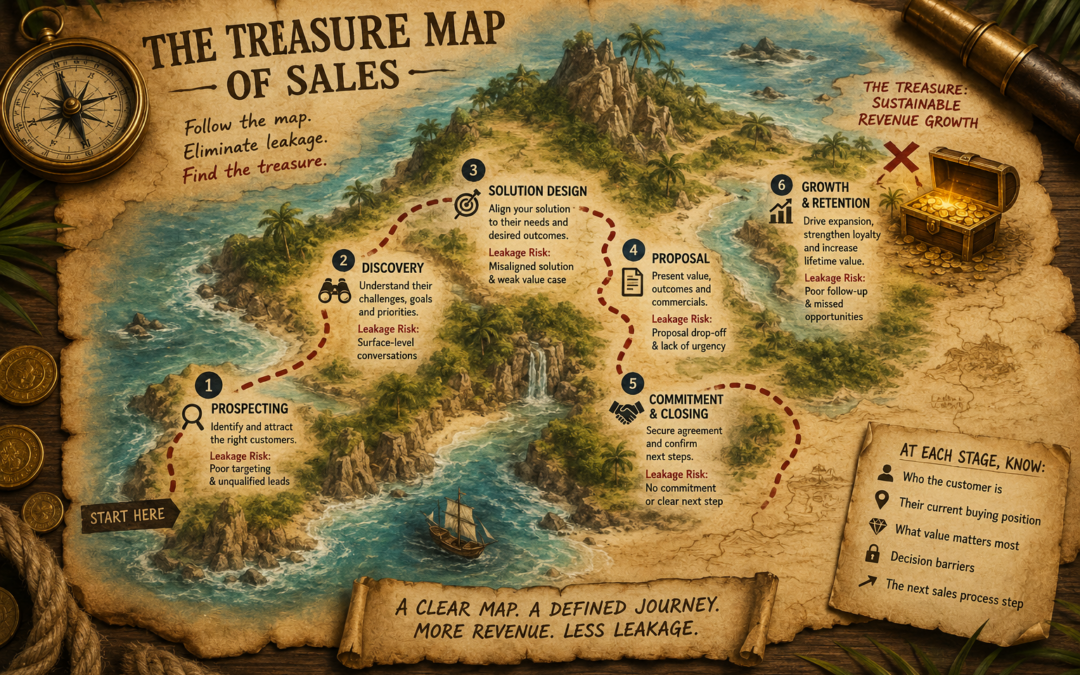
The Revenue Leakage Map
In complex sales environments, revenue is rarely lost in one dramatic moment. More often, it leaks away gradually — through missed conversations, poor qualification, weak value positioning, inconsistent follow-up, or uncertainty around the next step in the customer journey. This is where a Revenue Leakage Map becomes one of the most powerful tools in modern selling.
At Sales Impact, we view the sales process as a treasure map — not a scavenger hunt.
A scavenger hunt is random, reactive, and disconnected. Salespeople chase opportunities without a clear process, hoping something closes along the way. A treasure map, however, is deliberate. Every stage is marked. Every checkpoint matters. Every customer interaction has a purpose and a next step.
A Revenue Leakage Map visually tracks the entire customer sales journey, from prospecting to closing and beyond. It identifies where opportunities commonly “leak” out of the pipeline and why momentum is lost.
Typical leakage points include:
• Poor prospect qualification
Sales teams spend time on customers who are not decision-ready, financially viable, or strategically aligned.
• Weak discovery conversations
If pain points, operational challenges, and commercial impact are not uncovered early, the value of the solution remains unclear.
• Selling on price instead of value
When value is not established, the discussion defaults to price comparison — reducing margins and weakening differentiation.
• No defined next step
Many opportunities stall simply because there is no agreed follow-up action, timeline, or customer commitment.
• Proposal drop-off
Quotations are sent without stakeholder alignment, measurable business outcomes, or commercial urgency attached.
• Post-sale disengagement
Revenue leakage also occurs after the sale through poor account growth, low retention, and missed expansion opportunities.
The impact of leakage compounds throughout the sales cycle. A weak opening conversation creates poor qualification. Poor qualification leads to weak proposals. Weak proposals create delayed decisions, discounting pressure, and lost revenue.
The purpose of the Revenue Leakage Map is not just to identify problems — it is to create visibility, accountability, and strategic movement through the sales process.
At each stage of the map, sales professionals should clearly identify:
• Who the customer is
• What their current buying position is
• What value matters most to them
• What decision barriers exist
• What is the next sales process step
High-performing sales organisations do not leave customer movement to chance. They follow a structured map that guides opportunities forward with intention.
Because in sales, the treasure is not found by wandering. It is found by following a well-defined Sales Process Map.
This is an exciting sales process exercise that gives management and the sales team insight into where revenue leakage occurs and how to stop the leaks.
About the Author
Cedric Glynn
Cedric has years of experience in senior management within the corporate environment, both locally and internationally. He brings a wealth of knowledge and hands on experience which translates into the classroom environment in practical and up to date sales training courses.